
Is that beautiful palo verde in your front yard leaning a little more than it used to, especially after last night’s monsoon storm? Or are you worried about those overgrown mesquite branches creeping a little too close to the power lines? As a Phoenix homeowner, you know our trees are valuable assets, providing much-needed shade and beauty. But you also know they can become serious liabilities if not properly managed.
For many homeowners across the Valley, knowing when a tree needs professional care is the first step in protecting their property. This guide will help you spot the warning signs, understand the process, and make the best decisions for your landscape.
When Your Tree Becomes a Liability
That mature tree providing incredible shade might actually be more of a risk than an asset. Learning to spot the warning signs is part of responsible homeownership, helping you take action before a potential problem turns into a costly disaster.
As local experts serving the entire Phoenix Metro Area, we’ve seen it all—from invasive roots cracking foundations in Scottsdale to overgrown branches getting tangled in power lines over in Glendale. Knowing what to look for empowers you to make the right call for your property and keep your family safe.
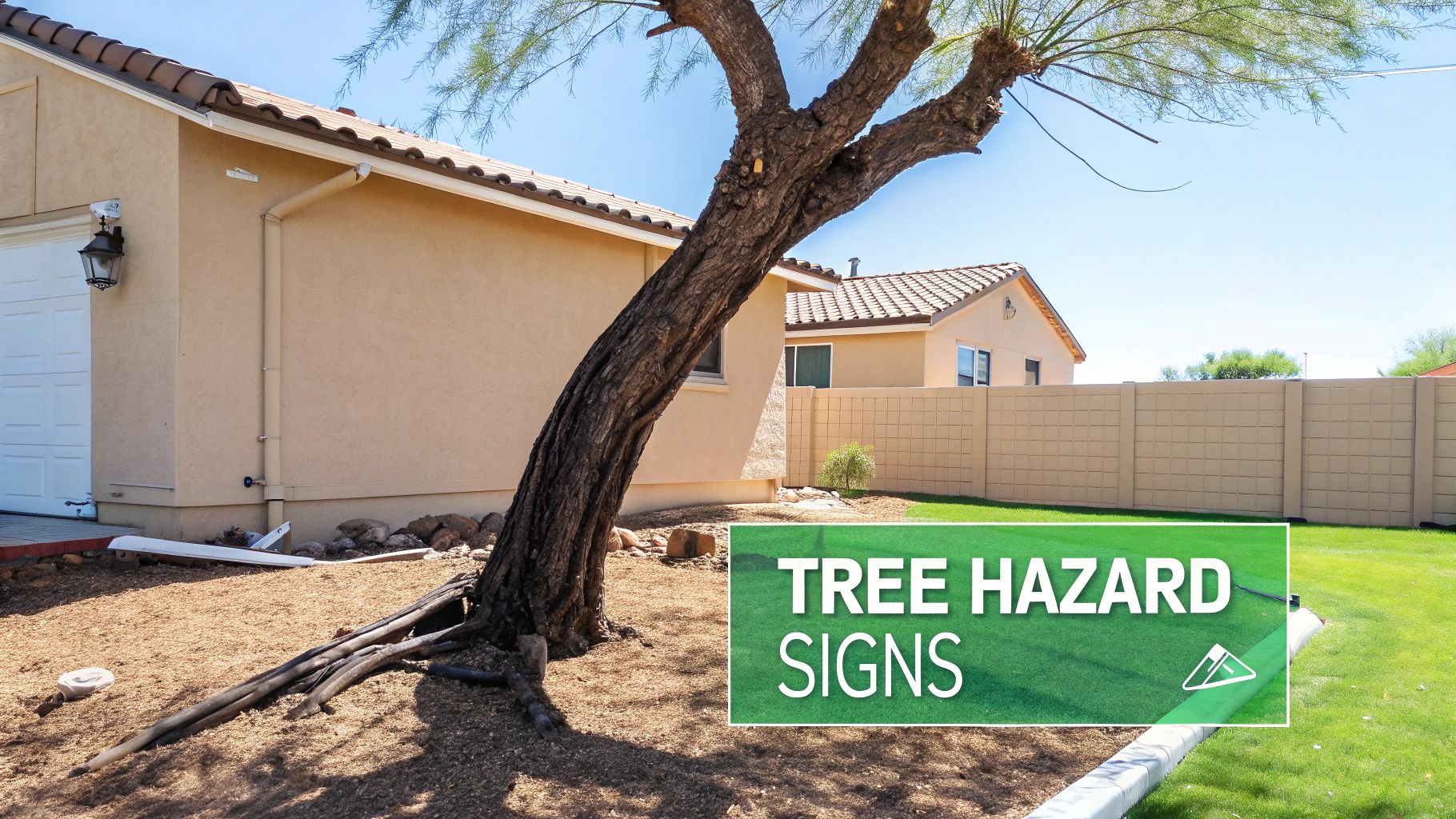
Signs Your Tree Needs Professional Attention
Not every tree with a few dead branches needs to come down. However, certain symptoms are clear indicators that a tree’s health or structural integrity is compromised, turning it from a beautiful landscape feature into a major hazard.
Here are the most common red flags we see in yards from Peoria to Mesa:
- A Sudden or Severe Lean: If your tree has always had a slight lean, it’s probably fine. But a sudden or worsening lean, especially after a storm, is a huge red flag for root failure.
- Deep Cracks or Cavities in the Trunk: Large vertical cracks, sunken areas of dead bark (cankers), or hollow spots are serious weak points. They compromise the tree’s core strength and can cause it to fail under stress.
- More Than 50% Dead Wood: If over half the tree is made up of dead or dying branches, it’s often too far gone to save. It’s likely battling a severe disease or pest infestation and has become dangerously unstable.
- Signs of Disease or Pest Infestation: Keep an eye out for peeling bark, mushrooms growing at the base of the trunk, or fine, sawdust-like material. These can signal internal decay or destructive insect activity.
- Damaged Root System: Nearby construction can wreck a root system. So can roots that are lifting sidewalks or pushing against your home’s foundation. Damaged roots can’t support the tree’s massive weight, making it a serious fall risk.
- Too Close for Comfort: Sometimes a tree is simply growing too close to your house, utility lines, or a neighbor’s property. If careful pruning can’t solve the safety risk, removal might be the only option.
If you spot any of these signs, it’s time to call an ISA Certified Arborist for a professional risk assessment.
Proactive evaluation is always better than a reactive emergency call. Learning about preventative tree care planning to avoid costly removals can save you a ton of money and stress by catching problems early.
Understanding Phoenix Tree Removal Costs
When you get an estimate for tree removal, you might wonder why there isn’t a simple, flat-rate price. The truth is, no two tree removal jobs in Phoenix are ever the same. Several critical factors come into play, turning each project into a unique puzzle that requires a careful, on-site assessment.
Let’s break down exactly what goes into that quote. The price boils down to a combination of risk, labor, and equipment. A small, accessible tree in an open yard is a straightforward job. But a massive, dying eucalyptus leaning over your pool and block wall? That’s a whole different ballgame. Understanding these variables will help you see the value behind the numbers.
Key Factors That Influence Your Quote
Think of it like this: the more complex and dangerous the job, the more time, skill, and specialized equipment it demands. A seasoned arborist looks at the situation from every angle to make sure the job gets done safely and efficiently.
Here are the main cost drivers we evaluate for homeowners from Avondale to Paradise Valley:
- Tree Size and Height: This is the biggest one. A small tree under 30 feet takes a lot less equipment and time than a towering 80-foot palm. Taller trees often require advanced rigging techniques and sometimes even a crane to safely lower huge sections to the ground.
- Tree Species: The type of tree absolutely matters. A dense, hardwood ironwood or mesquite is way tougher and heavier than a soft, fibrous palm tree. This directly impacts the time and effort needed to cut it up and haul it away.
- Location and Accessibility: Can our crew easily get to the tree with a bucket truck and wood chipper? Or is it tucked away in a tight backyard in Tempe, forcing our team to climb and carry every single piece of debris to the front by hand? Limited access adds a lot of labor time.
- Proximity to Hazards: If a tree is hanging over your home, power lines, pool, or outdoor kitchen, that’s a major cost factor. Working around these obstacles requires immense precision and advanced rigging to prevent property damage, making the job much more complex.
At its core, the cost reflects the level of risk involved. A tree overhanging your home requires a methodical, piece-by-piece dismantling process, which is far more intricate than simply felling a tree in an open field.
Optional Services and Their Impact on Price
Getting the tree on the ground is just one part of the job. What happens next also affects your final investment. These services make sure your property is left clean, safe, and ready for whatever you have planned.
- Stump Grinding: Taking down the tree leaves a stump behind. Stump grinding is an add-on service that grinds the stump down below ground level, getting rid of a tripping hazard and preventing pests from making a home there.
- Debris Hauling: Our standard service includes hauling away all the branches and logs. Some clients with fireplaces ask to keep the larger logs, which can slightly adjust the final price.
- Meticulous Cleanup: We pride ourselves on leaving your yard cleaner than we found it. This means raking, blowing away sawdust, and making sure no debris is left behind.
In Phoenix, Arizona, the cost of tree removal can vary quite a bit depending on these factors. Small trees (under 30 feet) can range from $150 to $500. Medium trees (30-60 feet) might cost between $300 and $1,000. For large trees over 60 feet, especially those near structures, costs can climb from $650 to over $2,700 because of the need for heavy machinery and heightened safety measures.
Professional tree services rely on solid systems to track jobs and costs effectively, which helps ensure accurate and transparent pricing. This efficiency allows us to provide fair quotes for every job, whether it’s routine palm tree trimming Glendale AZ or a complex removal.
Ultimately, investing in professional service isn’t just about removing a problem tree—it’s about protecting your most valuable asset: your home. You might be surprised to learn how regular tree maintenance can save you money in the long run by preventing these bigger, more expensive removal jobs from happening in the first place.
Do I Need a Permit to Remove a Tree in Phoenix?
Before you fire up the chainsaw, you need to know it’s not always that simple. Here in the Phoenix Metro Area, cities like Scottsdale and Phoenix have specific rules in place to protect our urban canopy.
These ordinances exist to preserve native species and maintain the unique character of our historic neighborhoods. Getting familiar with the local regulations is the first step to a smooth, hassle-free tree removal project.
When You Might Need a Permit
The number one reason you’ll need a permit is if the tree is a protected native species. This is almost always the case for our iconic Saguaro cactus, which is shielded by state law. On top of that, certain native trees like ironwoods or some mesquites might also have protections under local city codes.
Another big factor is where you live. If your home is in a designated historic district or a community with a strict homeowners association (HOA), you can bet there are rules about altering the landscape—and that includes tree removal.
The goal of these ordinances is to strike a balance between a homeowner’s rights and preserving our one-of-a-kind desert environment. An experienced tree service gets this, and can walk you through the requirements for your specific area, from Cave Creek to Chandler.
How to Check the Rules in Your Area
The best place to start is your city’s website—look for the planning, zoning, or parks and recreation department pages. Most of them lay out their tree ordinances pretty clearly.
Here are a few common situations where a permit is almost a sure thing:
- Protected Native Species: Taking out a Saguaro nearly always requires a permit from the Arizona Department of Agriculture. Other native trees could be protected by your city’s specific rules.
- Historic Preservation Zones: Homes in historic neighborhoods often have regulations covering everything from paint colors to landscaping to keep the area’s character intact.
- HOA Covenants: Your Homeowners Association has its own set of rules (CC&Rs) that will likely require you to get approval before any major tree work begins.
At Shady Deal Tree Service, we’re familiar with the different city codes all over the Valley. Part of our service is to check if a permit is needed for your project and guide you through the paperwork, making sure everything is done by the book.
The City of Phoenix, in particular, is serious about growing its urban forest. You can read more about Phoenix’s efforts to create a more equitable tree canopy. This initiative shows why cities are so invested in managing their tree populations carefully.
For a reliable tree service in Phoenix AZ, our team serves the entire Phoenix Metro Area. Contact Shady Deal Tree Service today for a free consultation.
Why You Should Hire an ISA Certified Arborist
When a tree needs to come down, it’s tempting to find the quickest, cheapest “tree cutting” service out there. But there’s a huge difference between someone who just owns a chainsaw and a genuine tree care professional. For any complex or high-risk removal, hiring an ISA Certified Arborist isn’t just a smart move—it’s the best way to protect your property, your wallet, and your peace of mind.
An arborist brings a deep, scientific understanding of tree biology, advanced safety protocols, and precision techniques that a simple tree cutter just doesn’t have.
An Arborist’s Expertise Goes Beyond Cutting
A certified arborist knows how to dismantle a tree with surgical precision. This is absolutely critical in the tight residential neighborhoods we see all over Scottsdale and Phoenix, where one wrong move could send a multi-ton limb crashing through your roof.
An ISA (International Society of Arboriculture) Certified Arborist has passed a tough exam covering every facet of arboriculture and must complete ongoing education to maintain their certification. It’s your guarantee of a higher standard of work. This certification means they’re proven experts in:
- Advanced Rigging Techniques: Safely taking down massive trees piece by piece, using specialized ropes and equipment to lower heavy sections with total control.
- Tree Risk Assessment: Spotting structural weaknesses, disease, and potential failure points that an untrained eye would easily miss.
- Safety Protocols: Following the strictest industry safety standards (ANSI Z133) to protect your property and their crew.
- Tree Biology and Health: Understanding how trees grow and react, which helps them determine if removal is even the only option.
Hiring a certified professional for tree care in Peoria AZ ensures the person in charge of your project has proven, tested expertise.
Why Certification Is Non-Negotiable for Safety
Tree removal is consistently ranked as one of the most dangerous jobs in the country. A certified arborist will always start with a thorough site assessment, creating a detailed takedown plan that accounts for every possible risk.
An ISA Certified Arborist is your assurance of a safe, efficient, and professionally executed project. Their expertise protects your property, our crew, and your peace of mind from start to finish.
This proactive planning is what separates a professional operation from a risky gamble. We bring this exact standard of care to every job we do, from tree trimming Sun City AZ to complex removals in Gilbert.
If you’re curious about what it takes to earn this credential, you can learn more about what a certified arborist is and see for yourself why it matters so much.
Choosing the right team for your tree removal Scottsdale AZ needs is the most important step. At Shady Deal Tree Service, our ISA Certified Arborists serve homeowners throughout the Phoenix Metro Area, including Avondale, Buckeye, Carefree, Cave Creek, Chandler, El Mirage, Gilbert, Glendale, Goodyear, Litchfield Park, Mesa, New River, Paradise Valley, Peoria, Phoenix, Scottsdale, Sun City, Sun City West, Surprise, Tempe, and Youngtown.
What a Professional Tree Removal Really Looks Like
When you decide a tree needs to go, you want the job done right—safely, cleanly, and without any last-minute surprises. A professional removal isn’t about just showing up with a chainsaw. It’s a carefully choreographed process designed from start to finish to protect your property, our crew, and the surrounding landscape.
Knowing what to expect can give you real peace of mind. From the initial phone call to the final sweep of the rake, every step is deliberate.
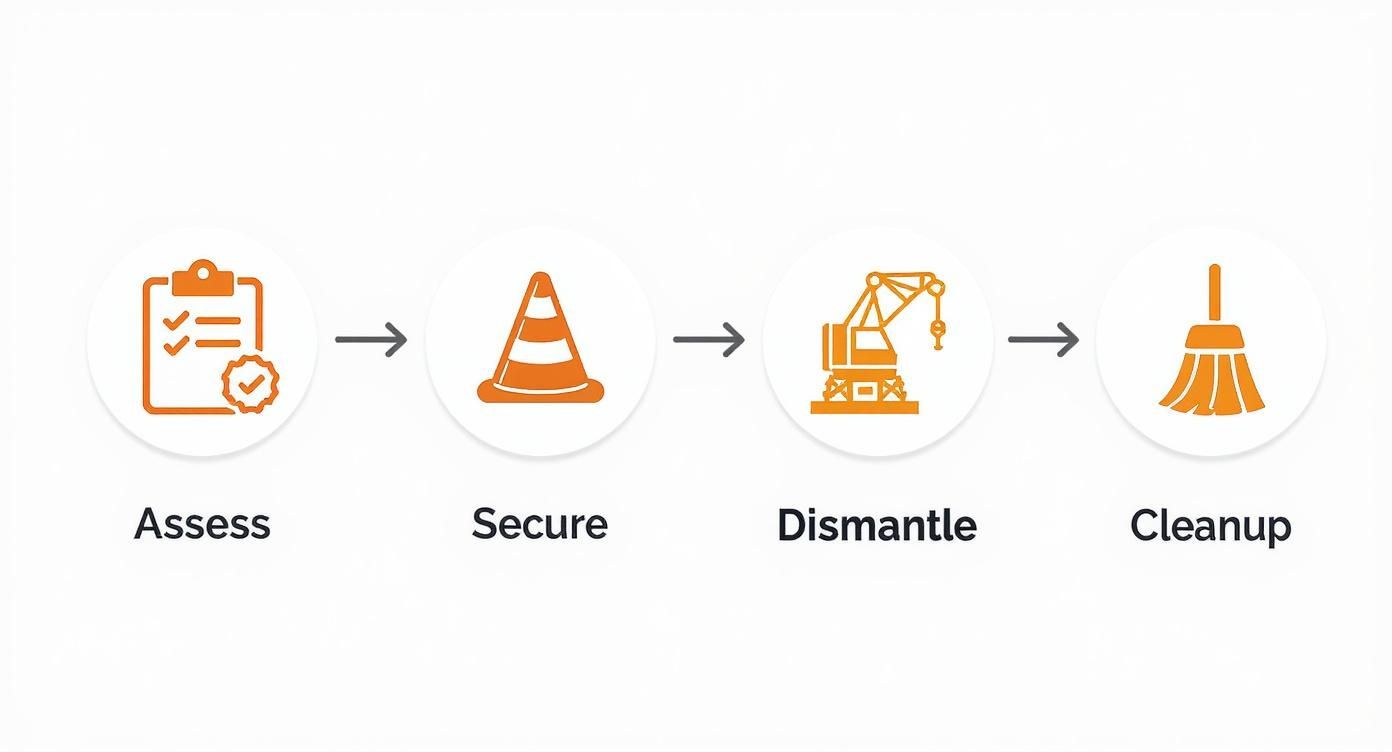
Step 1: On-Site Assessment and Safety Planning
Before a single cut is made, one of our ISA Certified Arborists walks your property to conduct a thorough assessment. We identify every potential obstacle—power lines, buildings, pools, and delicate landscaping—that needs to be protected. From there, we build a specific, strategic removal plan. This upfront planning is the bedrock of a safe and efficient operation.
The most important part of any tree removal happens before the saws even start. A detailed safety plan anticipates every challenge and ensures a smooth, predictable process from beginning to end.
Step 2: Establishing a Secure Work Zone
Safety is our top priority. The first thing our crew does on arrival is establish a clearly marked, secure work zone around the tree. This “drop zone” is a restricted area where branches and logs will be safely lowered. We make sure all family members, pets, and vehicles are well outside this perimeter before work begins. This step is a true mark of professional tree removal phoenix services.
Step 3: Methodical Tree Dismantling
In a residential setting, we almost never just “fell” a tree in one go. Instead, our expert climbers ascend the tree and dismantle it from the top down, piece by piece. Using advanced rigging techniques, we tie off large limbs before cutting them and carefully lower them to the ground with ropes. This controlled process is repeated until only the trunk remains. Our guide on why DIY tree pruning can be risky explains exactly why these specialized skills are so critical.
Step 4: Thorough Debris Removal and Cleanup
A job isn’t done until your property is spotless. As the tree comes down, our ground crew is already working to process the debris. Branches are fed into a powerful wood chipper, while larger logs are loaded onto our trucks to be hauled away. We take pride in leaving your yard even cleaner than we found it. That means raking up every last leaf, twig, and bit of sawdust.
What Happens After the Tree Is Gone
A professional tree removal isn’t over just because the tree is down. The job is only complete when your property is clean, safe, and ready for whatever comes next. This final phase—tackling the stump and handling the cleanup—is what separates a decent job from a truly five-star tree service Phoenix AZ experience.
Once we’ve hauled away the main trunk and limbs, you’re left with the stump. Just leaving it there is a bad idea. It’s a tripping hazard, a magnet for pests like termites and ants, and can even start sprouting new, unwanted growth.
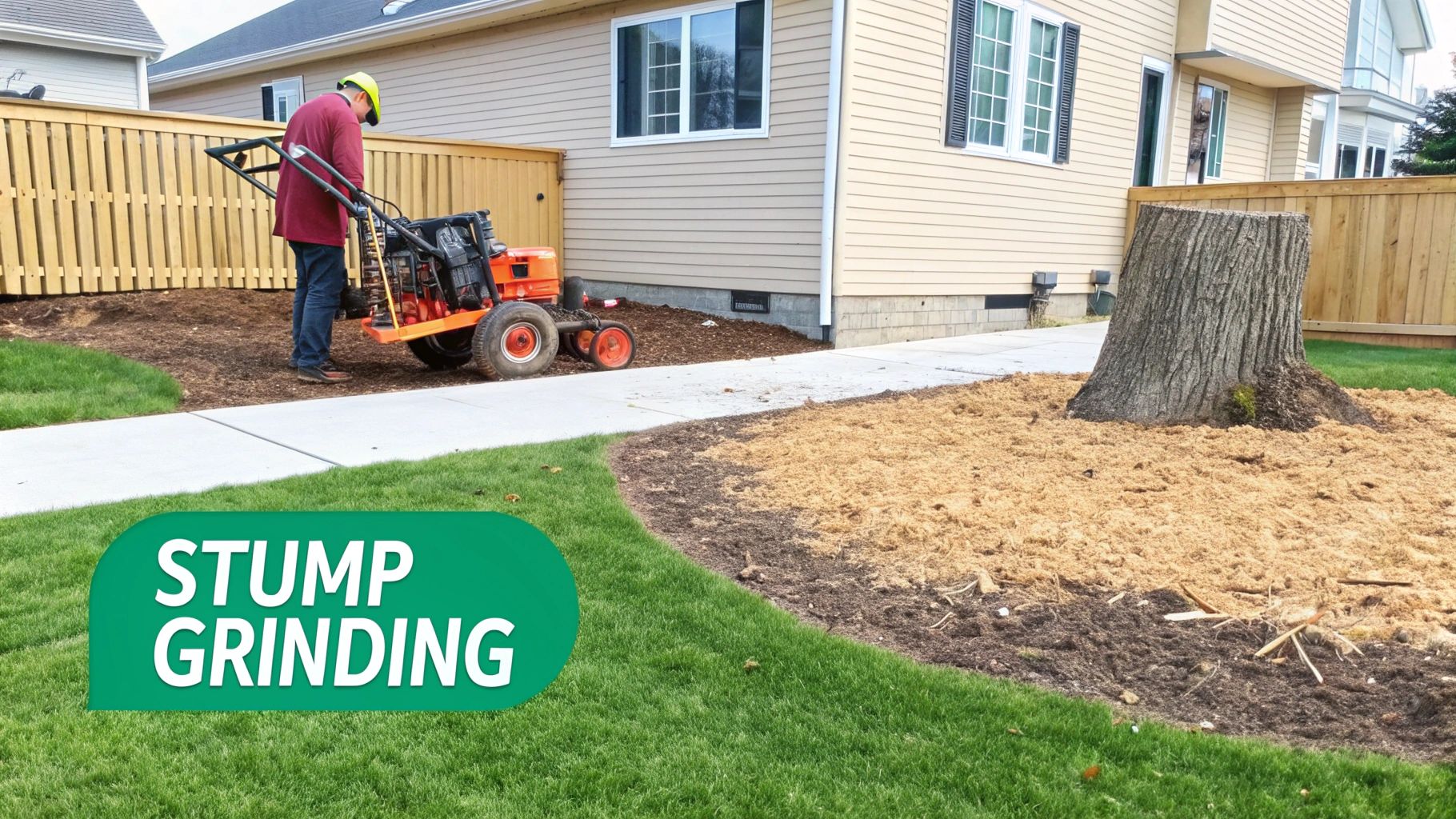
Stump Grinding: The Superior Solution
While “removal” might sound more thorough, stump grinding is the preferred method for residential properties. Complete removal means digging out the entire root ball—an incredibly invasive process that tears up a huge section of your yard.
Stump grinding, on the other hand, is much more precise. We use a powerful machine to grind the stump down 6–12 inches below the soil. This approach gives you several key advantages:
- It’s Less Invasive: Grinding only impacts the immediate area around the stump.
- It Eliminates Hazards: By taking the stump below ground, we get rid of the tripping risk.
- It Prevents Pests: Grinding away the stump removes the decaying wood that would attract termites and ants.
- It Creates Usable Mulch: The process leaves behind fine wood chips, which make a fantastic natural mulch for your garden beds.
Think of stump grinding as the final, perfecting touch on a tree removal project. It ensures a clean slate, turning a former hazard into a safe, usable space for your family to enjoy.
If you’d like to understand the differences in more detail, our guide on stump grinding vs. stump removal provides a complete breakdown.
Frequently Asked Questions About Tree Removal in Phoenix
How often should I have my trees inspected in Arizona?
For most mature trees in the Phoenix area, we recommend a professional inspection by an ISA Certified Arborist every 1-2 years. However, you should always have your trees checked after a severe monsoon storm to look for new cracks, leans, or other damage.
Can I remove a tree myself to save money?
While it might seem cheaper, DIY tree removal is extremely dangerous and can lead to costly property damage or serious injury. Hiring a licensed and insured professional with the right equipment is the only way to ensure the job is done safely and correctly.
What happens to the tree roots after removal?
Once the tree is cut down and the stump is ground out, the remaining root system underground will stop growing and naturally decay over time. These decomposing roots will not cause new problems and will actually add nutrients back into your soil.
How can I prepare my trees for monsoon season?
Preparing for monsoon season is crucial for Arizona homeowners. Start by having a certified arborist inspect your trees for weak or dead branches that could break in high winds. Proactive trimming and pruning can thin the canopy, reducing wind resistance and making the tree much safer.
At Shady Deal Tree Service, our goal is to help you keep your trees healthy, safe, and beautiful. By providing expert insights and professional care, we protect your property and give you peace of mind.
Ready to handle that problem tree? The ISA Certified Arborists at Shady Deal Tree Service are here to help homeowners across the Phoenix Metro Area.
Call 623-703-2536 or visit shadydealtreeservice.com to schedule your free tree service estimate today.